
What is Community Energy?
Community energy projects are wholly or partly owned by local community groups. Instead of profits flowing to distant investors, income from renewable energy installations stays in the area, funding further projects and community programmes.
These projects provide secure, locally generated electricity, reduce carbon emissions, protect people from rising energy bills and create jobs and volunteering opportunities. In the UK, most community energy schemes use a share‑financing model where residents invest in projects close to their hearts and receive a modest return. CEP follows the same democratic model.
Our Community Energy Model
Identify Rooftops
- Preston has thousands of square metres of unused rooftop space. We work with schools, colleges, businesses and public organisations that have large roofs suitable for solar PV installation.
Community Investment
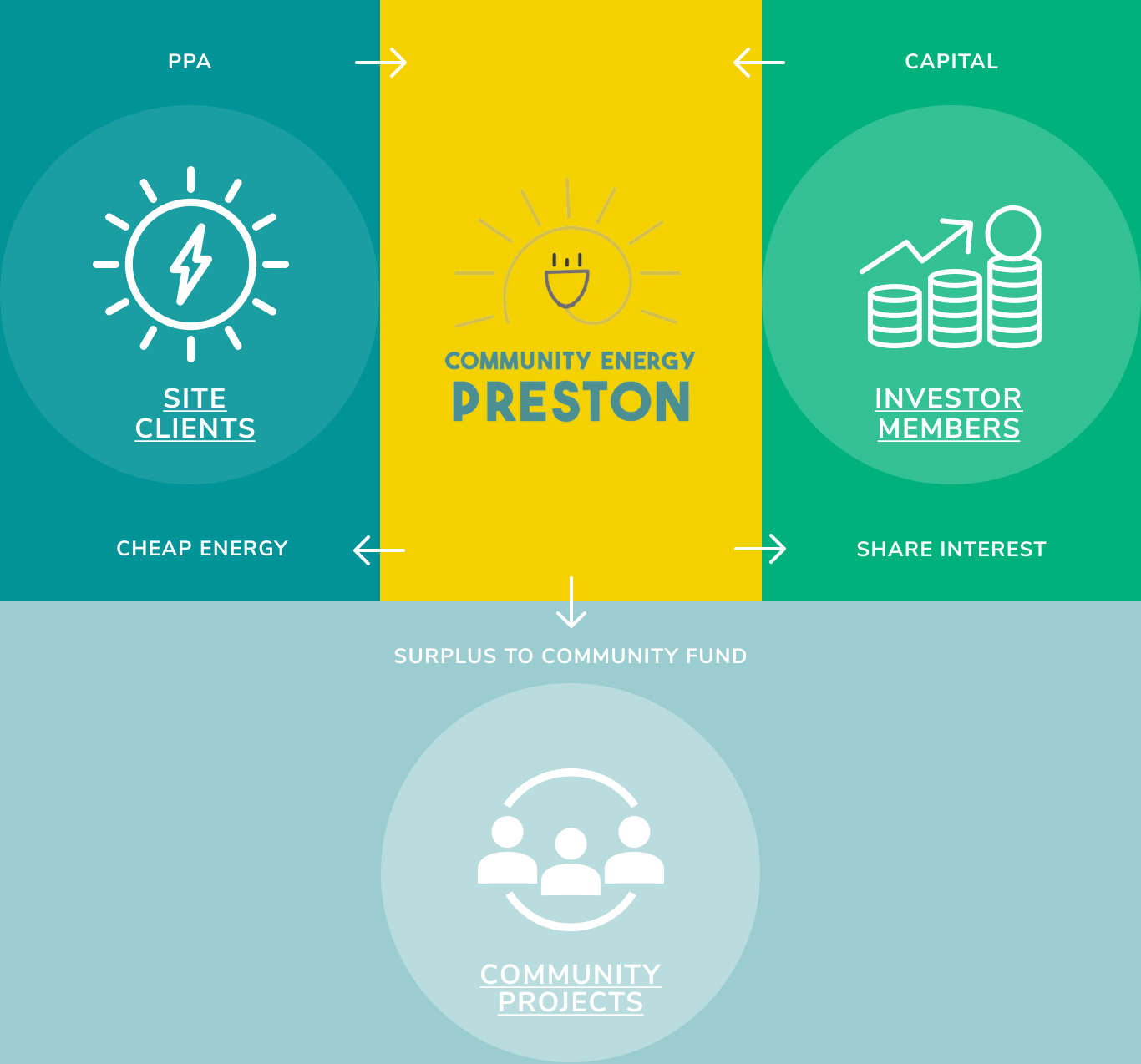
- Local residents and supporters invest through a community share offer. Even small investments make a difference and automatically enrol investors as members of our Community Benefit Society
Install Solar Panels
- We provide the capital and manage feasibility studies, pre‑construction, installation, operation and maintenance. Our partners handle technical aspects and grid connection
Sell Renewable Energy
- Host organisations buy the electricity through a long‑term Power Purchase Agreement at a rate lower than typical market prices. Building owners, corporates and individuals can also purchase 100 % community‑owned renewable energy
Reinvest Surplus
- After paying investors a modest return, surplus profits are channelled into a community fund to support local projects, tackle fuel poverty and nurture green spaces. Members vote on how surplus funds are spent
The Preston Model
The “Preston Model” is a term applied to how the council, its anchor institutions and other partners are implementing the principles of Community Wealth Building within Preston and the wider Lancashire area. This model is founded on four principles, that involves localising expenditure on the procurement of goods and services, building a skilled and committed workforce, encourage the development of new businesses, and supporting the growth of alternative models of economic governance which give citizens greater investment in and control over their economic future.
Community Energy Preston are seeking to improve community wealth by cutting energy bills for businesses and community buildings across the North West. Community Energy Preston will be helping those in fuel poverty through renewable energy and energy efficiency improvements. Initially this will be largely through solar installation through tried and tested methods done by hundreds of community groups. As we build a community fund we will have more flexibility to do a wider variety of projects, and support local residents however we can. Community wealth building is at the heart of Community Energy Preston, and we are grateful for the support of Preston City Council, and PCDN, in our activities.
More Information About The Preston Model
Frequently Asked Questions
- How much can I invest and what return will I get?
Community share offers typically start from a low minimum (often £50), making it accessible for most people. Returns vary by project but are designed to be fair and sustainable rather than high‑risk.
- Can I withdraw my investment?
Shares are withdrawable subject to notice periods and project terms. Investments are in community benefit societies rather than listed companies; please read the share offer document carefully.
- Is my money safe?
Community energy projects carry risks like any investment. CEP carries out due diligence, feasibility studies and uses proven UK models to minimise risk. Your investment is not covered by the Financial Services Compensation Scheme.
- Where does the money go?
Funds raised pay for solar installations. Income from selling electricity covers operating costs, pays investors interest and funds community projects. Case studies from other groups show that community energy projects can save more than 165,000 tonnes of CO₂ in a year.
- What happens if I move away?
Membership is tied to you, not your address. You can remain a member or withdraw your shares according to the terms of the share offer.